Legend of Avatar
- 4.5
- Rating
- 500.00K
- Installs
- Free
- Price

 Analysis by App-foxy
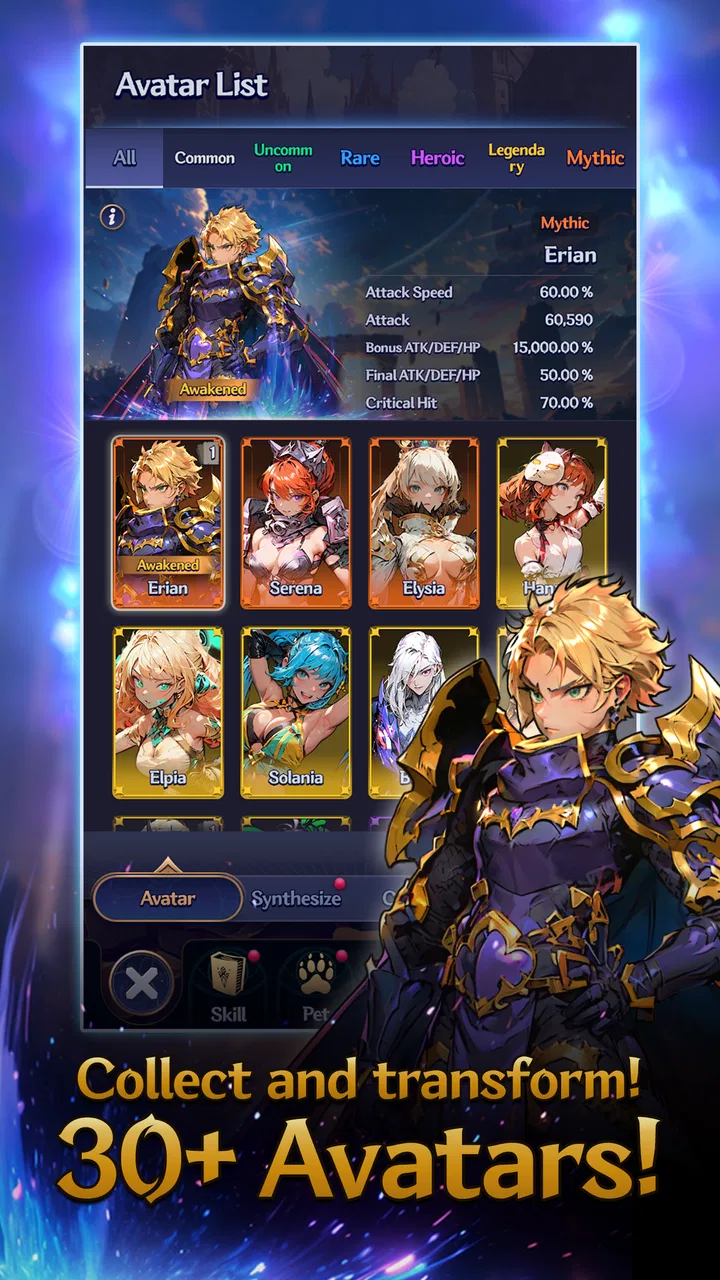
I approached Legend of Avatar as a quick role-playing game rather than a title that demands a long, uninterrupted session. Its central appeal is easy to understand: progress continues through idle play, while heroes can transform as they develop. That combination makes it suitable for checking in between ordinary tasks, but it also means the most satisfying moments come from making sensible choices around your progress instead of constantly controlling every battle.
Developed by BillionaireGames, the game is free to start and aimed at a Teen audience. It has already passed half a million installs and holds a 4.5 average from roughly thirty-seven thousand ratings, which suggests that its simple pick-up-and-check rhythm has found a sizeable audience. I would not treat those figures as a guarantee that it will suit everyone, though. Idle role-playing games can feel wonderfully convenient to one player and frustratingly hands-off to another.
What the first session feels like
The first thing I noticed is that the game asks me to think in terms of momentum. I am not expected to win every encounter through rapid taps or complicated movement. Instead, the useful questions are: which hero deserves attention, when is a transformation worth pursuing, and what should I do with the rewards collected while I was away?
You May Also Like

 Blood Strike: 2.5 Anniversary
Blood Strike’s Loadouts Turn Every Drop Into a Tactical Gamble
A close look at Blood Strike’s custom loadouts: how fast access to signature weapons reshapes its battle royale rhythm, rewards preparation, and narrows the gap between fights.

 Pandora - Music & Podcasts
Pandora’s Music Is Easy to Start, but Harder to Recover
Pandora’s strength is its low-effort path from a seed to a station. Its weak spot is how much confidence it asks you to place in connection, setup, and quiet recovery.

 8 Ball Pool
 Is Built on Rivalries, Rematches, and Routine
A close look at the rivalries, rematches, shared routines, and unanswered safety questions that turn a quick pool match into a persistent mobile community.

 Samsung Music
’s Quiet Strength Is Playing What You Already Own
Its reach comes less from spectacle than from dependable access to a personal library. That simplicity is both the app’s strongest retention engine and its ceiling.

 AccuWeather: Weather Radar
AccuWeather Review: A Quick, Clear Forecast for Everyday Decisions
For everyday plans, the best forecast is the one you can understand quickly. AccuWeather makes rain timing, radar, and local conditions easy to act on, with a few trade-offs.

 Hill Climb Racing
Why Hill Climb Racing Still Turns Crashes Into One More Run
A tiny car, a bumpy hill and one more upgrade: Hill Climb Racing keeps resurfacing because its simple chaos makes every near-miss feel personal.
More From Our News Desk



That makes the opening more approachable than a traditional role-playing game with a large map, many menus, and a long list of controls. If you are new to this style, the basic loop is reassuring: enter the game, inspect what has accumulated, improve the team, and send the heroes back into their next challenge. The game’s summary focuses on seamless growth, and that description matches the way the experience is meant to fit around your day.
At the same time, “idle” does not mean “completely automatic in every meaningful sense.” The game still asks for attention when a new improvement becomes available or when your current team stops progressing efficiently. If you simply open it, collect everything, and close it without checking your heroes, you may be leaving useful progress decisions untouched.
I found the best mindset was to see each visit as a short planning session. I would first claim whatever had built up, then look for the most immediate upgrade rather than spending resources impulsively. That order matters in games built around compounding growth: an improvement made early can influence several later battles, while a flashy purchase made without a plan may not solve the obstacle in front of you.
Who will enjoy this format
This is a natural fit for someone who wants a role-playing game that can be checked during a commute, a lunch break, or a short pause at home. It is also friendly to players who like watching a roster become stronger without manually fighting every encounter. The transformation theme gives the progression a visible sense of direction, so the game is not only about collecting rewards; it is also about seeing heroes move toward a more advanced state.
I would be more cautious if you want deep, moment-to-moment combat or a story that carries every session. Compared with an action-focused role-playing alternative, this game gives up direct control in exchange for convenience. Compared with a traditional turn-based game, it places less emphasis on carefully selecting an action every round. That trade-off is the main decision to make before installing it.
Getting started without wasting the opening
After installing it, I recommend taking the first session slowly enough to understand the reward and upgrade rhythm. The temptation is to tap through every prompt as quickly as possible, but the opening is where you learn what the game considers important. Pay attention to which screen shows accumulated progress, where hero improvements are made, and how the game presents transformations.
The current version is 1.26.0, and it runs on Android 9 or later. That makes the operating-system requirement fairly accessible for many Android users, although anyone with an older device should check compatibility before planning around it. Since the game is free to download but includes optional purchases ranging from $2.49 to $99.99 for an item, I would also decide in advance whether I want to remain entirely free-to-play.
That decision is useful because idle games can make waiting feel more noticeable after the opening rush. I prefer to begin without spending, learn how quickly ordinary progress feels, and only then decide whether an optional purchase would genuinely improve my experience. The free starting point gives you room to make that judgement rather than forcing a payment before you understand the loop.
For a first-time player, the safest opening routine is straightforward:
- Let the initial guidance show you the basic progression path.
- Collect available rewards before attempting to solve a difficult stage.
- Improve the hero or heroes that directly support your next objective.
- Watch what changes after a transformation instead of assuming every upgrade has the same value.
- Close the game only after checking whether a new action is waiting for you.
This routine sounds simple, but it prevents a common mistake: treating every reward as something to spend immediately. In my experience, the useful question is not “Can I buy this now?” but “Will this help me pass the next meaningful obstacle?” That small change makes the early game feel more deliberate.
The first meaningful success
Your first satisfying success should be more than merely opening a reward screen. It comes when an improvement allows your heroes to continue through a challenge that had previously slowed them down. To reach that point, I would collect the idle earnings, strengthen the most relevant part of the team, and then return to the stage rather than scattering resources across every available option.
This is also where the transformation system begins to matter. A transformation is not just a visual milestone in my view; it is a reason to reassess how I am spending resources. If a hero changes role, strength, or usefulness after transforming, the best upgrade target may no longer be the one I favored a few minutes earlier. The practical tip is to pause after a transformation and inspect the whole team again.
That pause is one of the less obvious habits that improves the experience. Players coming from conventional role-playing games often build a fixed favorite and keep investing in it automatically. In an idle game centered on growth and hero changes, that can create a mismatch between the hero receiving attention and the challenge actually blocking progress. I got better results by treating transformations as checkpoints for a new plan.
Another useful habit is to make the game part of an existing routine. For example, if I open it while waiting for a kettle to boil, I can collect progress, make one considered improvement, and leave. Later, during a longer break, I can review whether that decision moved the team forward. This approach keeps the idle design convenient instead of turning it into a reason to repeatedly reopen the app without a clear purpose.
Where new players can become confused
The biggest source of confusion is the difference between activity and progress. Because the game continues growing while you are away, it can feel as though every return should produce a dramatic leap. That will not always happen. Sometimes the correct action is a modest improvement followed by another period of waiting, and players who expect constant breakthroughs may mistake that pacing for a problem.
I also think the distinction between collecting and investing deserves attention. Accumulated rewards are satisfying to claim, but claiming them does not automatically mean the account is optimized. Before spending, identify the barrier in front of you. If the team is failing because a particular hero is underdeveloped, spreading resources evenly may be less effective than addressing that weakness directly.
Transformations can create a second kind of uncertainty. A new form naturally feels important, but importance does not always mean “use every resource on it immediately.” I would compare the transformed hero with the rest of the roster and consider whether the next challenge rewards that direction. This is a small strategic layer that keeps the game from becoming a completely passive reward collector.
Another point worth understanding is that idle progress does not remove the need for returning at sensible intervals. If you leave the game alone for too long, you may come back to a full set of rewards but no clear memory of what you were trying to improve. I found it helpful to end each session with a simple intention, such as focusing on one hero or preparing for the next obstacle. That makes the next visit easier to read.
Purchases can also affect expectations. The game is free, but the presence of optional items means some players may be tempted to spend when progress slows. My advice is to avoid buying anything merely because a timer or difficult encounter feels irritating. First check whether a better upgrade choice, a transformation, or a more patient idle cycle addresses the issue. If the game still feels too slow without spending, that is useful information about whether its design suits you.
How it compares with familiar role-playing games
Against a conventional action role-playing game, Legend of Avatar is calmer and less demanding. You will not get the same satisfaction from precise movement or actively controlling every attack. In return, you can make progress while your attention is elsewhere and return for a compact management session. For a busy player, that convenience is not a minor feature; it changes whether the game fits into real life at all.
Against a traditional turn-based role-playing game, the difference is more subtle. Both can involve planning a team and improving heroes, but this game places more weight on long-term growth and less on choosing a response during each individual battle. If you enjoy studying enemy patterns and selecting commands repeatedly, another style may feel richer. If you prefer making a few decisions and then watching the results unfold, this approach is more comfortable.
It also differs from a purely casual clicker because the hero transformation theme gives the progression a role-playing identity. You are not only watching a number rise; you are following a roster whose development shapes how the next stage feels. Still, players seeking a large narrative world should keep their expectations measured. The appeal here is the growth loop, not the kind of exploration associated with a sprawling console-style adventure.
That comparison helped me place the game correctly. I would recommend it to someone who wants a low-pressure companion game alongside a more demanding title. I would not recommend replacing a favorite action game with it if the main reason you play is the thrill of direct control. The two experiences solve different problems.
Small habits that make progress feel better
The first habit is to separate routine collection from decision-making. Collecting rewards can be automatic, but spending them should be deliberate. I like to look at the next obstacle first, then choose the improvement that has a clear connection to it. This avoids the common idle-game trap of upgrading whatever button happens to be highlighted.
The second is to use transformations as review points. After a hero changes, reassess the team rather than following yesterday’s plan. This is especially useful when your earlier strategy was built around one favorite. A transformed hero may deserve attention, but the correct answer depends on the current challenge and the balance of the roster.
The third is to judge purchases by time saved, not by excitement. An item may look attractive because it produces an immediate jump, yet the better question is whether it changes your regular play pattern. If it only creates a brief burst before the same frustration returns, keeping your money is sensible. The game’s free entry makes it possible to learn that pattern first.
A fourth habit is to keep sessions purposeful. I would rather make one informed adjustment than tap through every menu repeatedly. The idle design works best when it reduces the pressure to be constantly present. If you find yourself checking without a goal, close the game and return later; the experience is supposed to support your schedule, not dictate it.
Who should skip it
I would skip this game if I need a role-playing experience where my skill with controls determines the outcome of each fight. The idle structure intentionally removes much of that responsibility. I would also look elsewhere if I dislike waiting between meaningful upgrades or if I find optional purchases distracting. Even a well-designed free game can feel uncomfortable when its pacing conflicts with your preferred style.
It may also be a poor choice for someone who wants a single long story with a clearly directed ending. The appeal here is ongoing development: return, improve, transform, and continue. That can be relaxing, but it is not the same as moving through a carefully paced campaign. Knowing that difference before you start will prevent disappointment.
On the other hand, I think it is a strong candidate for a first idle role-playing game because the basic idea is easy to grasp. You do not need to commit to a long session to find out whether it works for you. Install it, follow the opening progression, wait for the first meaningful reward cycle, and see whether planning around hero growth feels satisfying.
My recommendation after settling into the loop
After spending time with the game, I see its strongest quality as convenience with just enough decision-making to keep the progress from feeling empty. The transformation focus gives me a reason to care about the heroes, while idle growth makes it possible to enjoy the game in short visits. That balance is the reason I would recommend it to a friend who wants a role-playing game that fits around work, study, or other games.
My reservations are equally clear. Progress can feel less exciting if you want constant interaction, and the optional purchase range means disciplined spending matters. The game is best when I accept its pace and use each visit to make one useful choice. It is less enjoyable when I expect it to behave like an action title or when I treat every slowdown as a problem that money should solve.
For a newcomer, my suggested path is to begin free, learn the reward cycle, reach a transformation, and then reassess whether the team is moving in the direction you want. Do not rush to copy a favorite upgrade pattern from another role-playing game; this title’s idle structure rewards checking the current obstacle and adapting. That is the most practical lesson I took from it.
Legend of Avatar is worth trying if you want a free role-playing game built around idle growth and hero transformations, especially when your available playtime comes in small pieces. Its 4.5 average and broad install base show that the format has appeal, but the real test is personal: if you enjoy returning to make compact strategic decisions, it can become an easy daily habit. If you need hands-on combat, a richer story, or no temptation to spend, choose a different kind of role-playing game instead.
FAQs for Legend of Avatar
01What is Legend of Avatar?
Legend of Avatar is a mobile role-playing game inspired by fantasy adventure worlds and team-based battles. Players collect heroes, improve their abilities, complete story stages, and participate in different combat modes. The game generally combines automated or semi-automated fighting with strategic decisions, such as choosing a balanced team, upgrading equipment, and using character skills at the right time.
02Is Legend of Avatar free to download and play?
Legend of Avatar can typically be downloaded for free on supported Android or iOS devices, but it may include optional in-app purchases. These purchases can provide resources, characters, upgrade materials, or other advantages that help progression. You can usually play without spending money, although progress may require more patience because some rewards, energy systems, advertisements, or upgrade timers can limit how quickly you advance.
03Does Legend of Avatar require an internet connection?
An internet connection is generally recommended or required for Legend of Avatar because the game may need to connect to online servers for account access, events, cloud progress, competitive modes, and in-app purchases. Offline access may be limited or unavailable. A stable Wi-Fi or mobile data connection is especially important during updates and battles that synchronize your progress with the game server.
04Is Legend of Avatar suitable for beginners?
Legend of Avatar is relatively accessible for beginners because early stages usually introduce the main systems gradually, including hero collection, combat, missions, and upgrades. However, the number of currencies, menus, events, and character-development options can feel overwhelming at first. New players should focus on a small core team, complete tutorial objectives, and avoid spending rare resources until they understand which heroes fit their preferred strategy.
05Are there advertisements or in-app purchases in Legend of Avatar?
Legend of Avatar may include advertisements and optional in-app purchases, depending on the version, region, and platform. Advertisements can sometimes offer bonus rewards, while purchases may provide premium currency, bundles, summons, or progression materials. Before downloading, check the official store listing for the latest information and review the device's purchase settings, particularly if children may access the game.
Pros
- Fast-paced battles are easy to learn
- even for casual players.
- The anime-inspired art style gives characters a colorful
- polished look.
- Multiple heroes encourage experimenting with different team combinations.
- Daily tasks provide useful rewards without requiring long play sessions.
- Guild features add social interaction and cooperative progression goals.
Cons
- Progress can feel slow without spending resources or waiting for upgrades.
- Combat may become repetitive after experiencing the main character abilities.
- Frequent menus and notifications can make the interface feel cluttered.
- Some rewards and features are locked behind account progression.
- Device performance may drop during busy battles on older phones.

Legend of Avatar
Gallery